

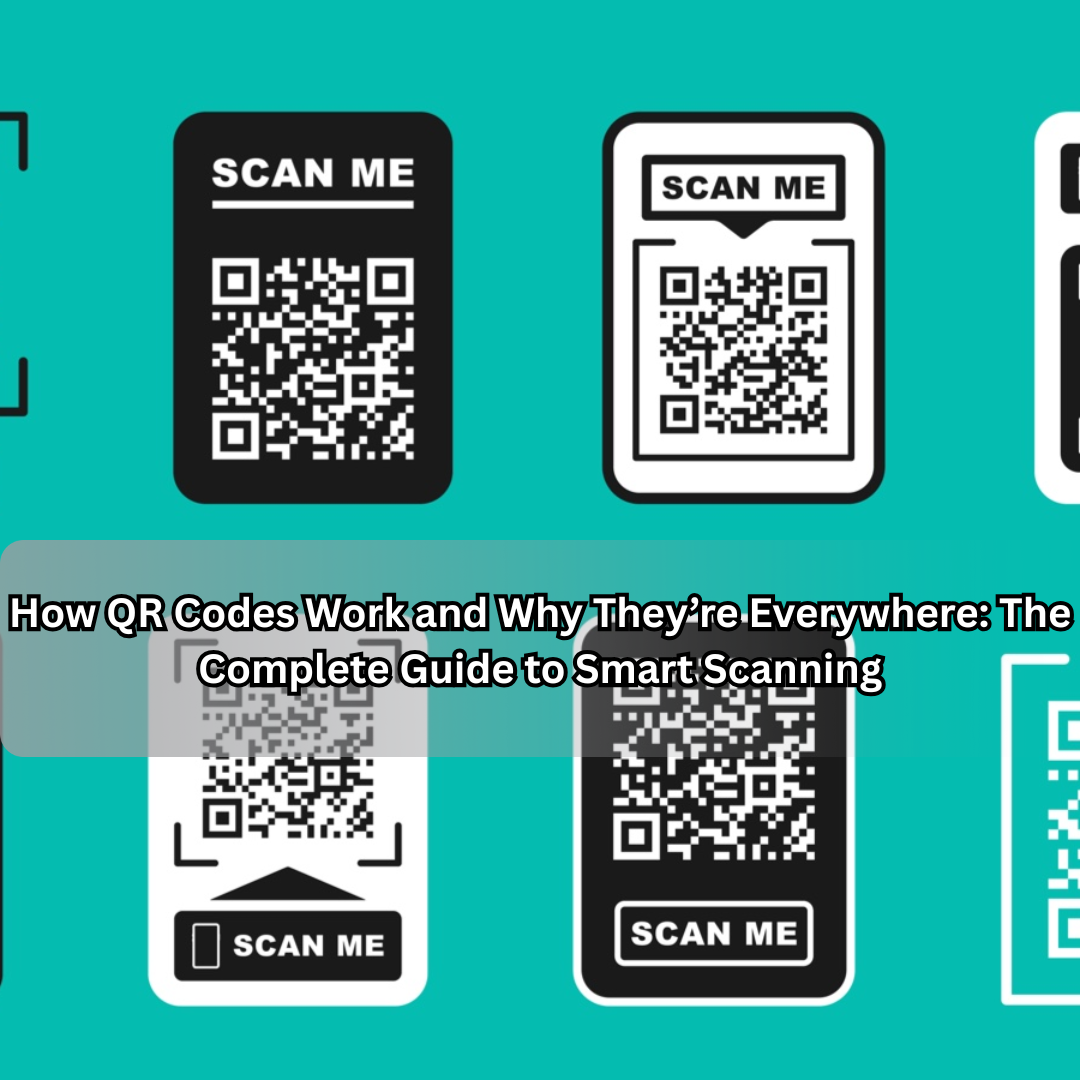
In the past few years, one small black-and-white pattern has quietly taken over the world — the QR Code.
You see it on restaurant menus, product packaging, business cards, payments, event tickets, even billboards.
You simply point your phone’s camera, and instantly — a website, payment link, or document opens.
But have you ever wondered how QR codes actually work or why they’ve become so common everywhere?
This article breaks down everything about QR codes — their working, evolution, structure, uses, and how they became an essential bridge between the physical and digital worlds.
What Is a QR Code?
A QR Code (short for Quick Response Code) is a two-dimensional barcode that can store information such as website links, product details, contact information, or payment data.
Unlike traditional barcodes, which store data only in a horizontal line, QR codes store information both horizontally and vertically, allowing them to hold much more data.
Originally invented in Japan for tracking car parts in manufacturing, QR codes have evolved into universal digital connectors.
In Simple Words:
A QR code is like a smart link — you scan it, and it instantly takes you to a digital destination.
History and Evolution of QR Codes
QR codes were developed in 1994 by Masahiro Hara, an engineer at Denso Wave, a subsidiary of Toyota.
Their original purpose was to help factories track automobile parts faster than standard barcodes.
Because they could store large amounts of information and scan quickly from any angle, they were named “Quick Response” codes.
Over time, industries beyond manufacturing — marketing, retail, healthcare, and finance — realized their potential.
The rise of smartphones with built-in cameras turned QR codes into a global phenomenon.
Today, they are used for payments, authentication, event check-ins, and digital marketing — practically everywhere humans interact with technology.
How QR Codes Work
At their core, QR codes use black and white squares arranged in a specific pattern to represent data.
Each square is a piece of binary information — a combination of 0s and 1s — that scanners interpret into meaningful content.
Here’s a step-by-step explanation of how it works:
1. Encoding Data
Text, URLs, or numbers are first converted into binary code.
That binary data is then encoded as a pattern of black (1) and white (0) squares on a grid.
2. Scanning
A camera or scanner captures the QR code image.
3. Decoding
Software analyzes the light and dark areas, converts the pattern back into binary, and then translates it into readable information (e.g., a website address).
4. Action
Once decoded, your device automatically performs an action — such as opening a webpage, adding a contact, or starting a payment.
This process happens in less than a second, hence the name “Quick Response.”
Structure of a QR Code
A QR code isn’t just random dots; it’s carefully designed with different sections that make scanning easy and error-proof.
1. Finder Patterns
The large squares at three corners help scanners identify the QR code’s position, angle, and size.
2. Alignment Patterns
Smaller squares that help the scanner read the code even if it’s tilted or distorted.
3. Timing Patterns
Alternating black and white lines that tell the scanner how large each module (square) is.
4. Data Area
The section that actually stores encoded data in binary form.
5. Quiet Zone
The white border around the QR code — necessary to separate it from surrounding content.
This smart design ensures QR codes can be scanned from any angle, in poor lighting, or even if partially damaged.
Types of QR Codes
There are several variations of QR codes, each suited for different purposes.
1. Static QR Codes
Contain fixed information that can’t be changed once created.
Used for:
- Product packaging
- Event tickets
- Printed brochures
2. Dynamic QR Codes
Store data indirectly through a short link or redirect URL that can be edited anytime.
Used for:
- Marketing campaigns
- Online menus
- Payment links
3. Micro QR Codes
Smaller and used where space is limited, such as on small parts or labels.
4. Frame QR Codes
Contain design frames and branding options, used in modern marketing.
5. QR Codes with Logos
Custom codes designed with brand logos in the center for better recognition.
Data That a QR Code Can Store
QR codes can hold a wide range of information types, such as:
- Website URLs
- Text messages
- Email addresses
- Phone numbers
- Social media links
- Wi-Fi network credentials
- Payment information
- GPS coordinates
Depending on complexity, a QR code can store up to several thousand characters.
Why QR Codes Became So Popular
QR codes existed for years, but their massive adoption came after a few key global shifts.
1. Rise of Smartphones
Every smartphone now includes a built-in camera and scanner — making QR usage effortless.
2. Contactless Solutions During the Pandemic
During the COVID-19 pandemic, QR codes became the go-to contactless tool for menus, payments, and check-ins.
3. Free and Easy Creation
Anyone can generate a QR code online in seconds — no technical skills needed.
4. Cross-Platform Compatibility
QR codes work across all devices and systems — Android, iOS, tablets, scanners, or POS machines.
5. Instant Digital Access
They eliminate the need to type URLs or download apps — just point and scan.
How Businesses Use QR Codes Today
Businesses use QR codes to connect physical and digital customer experiences seamlessly.
1. Marketing and Advertising
- Add QR codes on posters or flyers to redirect users to websites, coupons, or videos.
- Brands use them in TV ads to allow instant product purchases.
2. Restaurants and Cafes
- QR menus replaced paper menus during the pandemic.
- Customers can order, pay, and give feedback instantly.
3. Retail and E-Commerce
- On product packaging for details, authenticity verification, and warranty registration.
- For tracking inventory in warehouses.
4. Event Management
- Used for ticket scanning, attendee check-in, and access control.
5. Banking and Digital Payments
- QR codes are the backbone of contactless payment systems like UPI, PayPal, and other wallet apps.
6. Healthcare
- QR wristbands store patient data.
- Medicine packaging uses QR codes for dosage information and authentication.
7. Education
- Teachers share study material links or feedback forms via QR codes.
- Libraries use QR tags for quick resource access.
The possibilities are endless — any place that needs fast, paperless, or contactless interaction can use a QR code.
Benefits of QR Codes
1. Convenience
Scan and go — no need for manual typing or searching.
2. Speed
Instant access to links, apps, or payments.
3. Cost-Effective
Creating and printing QR codes is almost free.
4. Space Saving
Stores large amounts of data in a small square.
5. Eco-Friendly
Reduces paper use (especially for menus, brochures, tickets).
6. Contactless and Safe
Perfect for hygiene-sensitive environments.
7. Trackable (Dynamic QR Codes)
Marketers can track how many people scanned and from where.
How Secure Are QR Codes?
While QR codes themselves are not dangerous, malicious links can be hidden behind them.
Risks:
- Phishing websites disguised as payment portals.
- Malware downloads.
- Fake payment requests.
Tips to Stay Safe:
- Use trusted apps or built-in camera scanners.
- Avoid scanning unknown codes in random places.
- Check the URL before clicking any link that opens.
- Prefer dynamic QR codes from verified sources.
With basic caution, QR codes are extremely safe to use.
The Technology Behind QR Code Scanning
1. Image Recognition
Your camera captures the image and identifies the QR pattern.
2. Error Correction
QR codes use Reed-Solomon error correction to restore damaged or incomplete codes.
That’s why they still scan even when scratched or partially hidden.
3. Decoding Algorithm
The pattern is analyzed line by line to decode binary data back into readable text or links.
4. Action Execution
Your phone automatically interprets the decoded data — opening a website, dialing a number, or connecting to Wi-Fi.
QR Codes in Everyday Life
- Shopping: Price tags and product details.
- Payments: Digital wallets, UPI, PayPal, and crypto transactions.
- Transportation: Boarding passes and bus tickets.
- Healthcare: Vaccination certificates and prescriptions.
- Education: Study materials and attendance.
- Tourism: Location guides and ticket confirmations.
- Events: Concerts, conferences, and registrations.
QR codes have become part of everyday convenience, blending the physical and digital world seamlessly.
Future of QR Codes
The journey of QR codes is just beginning.
They’re evolving with new technology trends like AI, blockchain, and augmented reality.
Upcoming Innovations:
- Smart Dynamic QR Codes: Real-time tracking of user engagement.
- Blockchain Verification: Prevents fake or tampered codes.
- Augmented QR Codes: Interactive scanning for AR experiences.
- Voice-Enabled Scanning: Integration with AI assistants for hands-free use.
As digitalization grows, QR codes will remain the fastest and most accessible link between offline and online spaces.
Fun Facts About QR Codes
- A QR code can store over 7,000 digits or 4,000 characters.
- It can be scanned even if up to 30% of it is damaged.
- The design allows scanning from any direction — 360°.
- Japan was the first country to adopt QR codes at a national scale.
- QR codes can include color, logos, and artistic designs without losing functionality.
Conclusion
QR codes have redefined the way we interact with information.
What started as a factory tracking tool is now a universal key to the digital world.
They are simple, fast, reliable, and nearly cost-free — the perfect technology for a connected age.
From payments to promotions, education to healthcare, QR codes simplify life in ways we don’t even notice anymore.
And as long as humans need instant access, QR codes will continue to be everywhere.
